how to declutter your house without throwing everything away

Do you sometimes feel like your home is overflowing? Objects piling up, cupboards you open carefully, that one chair that has officially become a secondary wardrobe… Good news: decluttering your home does not mean throwing everything away or living in a minimalist catalogue-looking interior. The real goal is to create more space, more calm, and […]

Do you sometimes feel like your home is overflowing?

Objects piling up, cupboards you open carefully, that one chair that has officially become a secondary wardrobe…

Good news: decluttering your home does not mean throwing everything away or living in a minimalist catalogue-looking interior. The real goal is to create more space, more calm, and a home that genuinely makes your life easier.

When I work with clients, I often hear the exact same fear come up:

“But what if I regret it?”

So… we keep things. A lot of things. Too many things.

In this article, I’m going to share a simple method to help you declutter your home without guilt, without emptying the entire house in one weekend, and without ending up exhausted three hours later. The goal isn’t to have a perfect house — it’s to feel good in your home.

How to declutter your home without throwing everything away
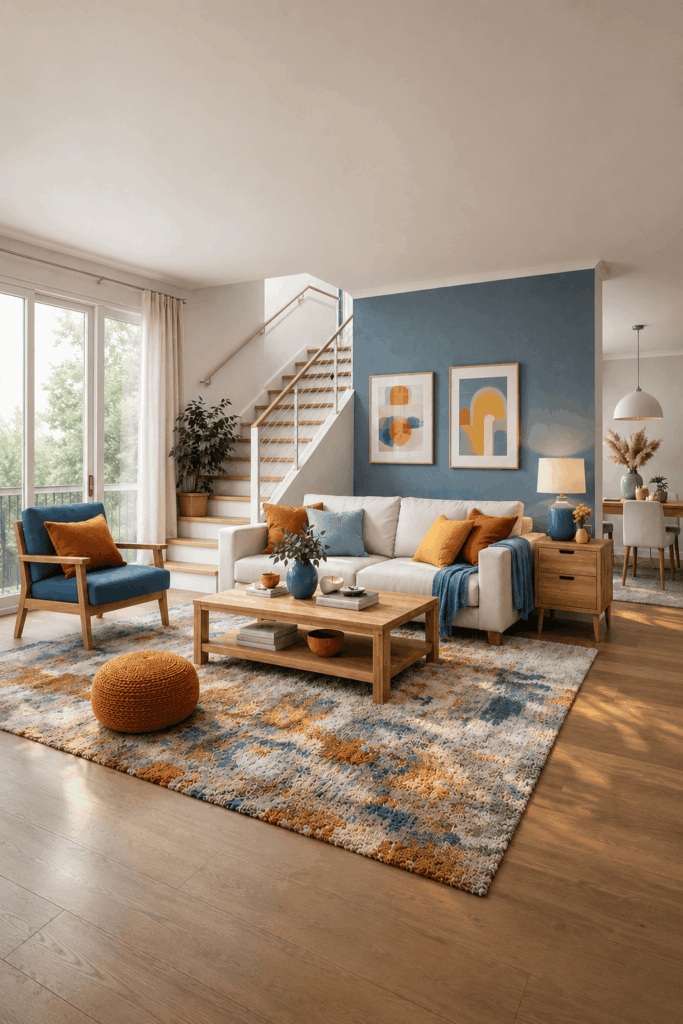
A clutter-free, well-organized interior

Step 1: Imagine your ideal home

Before you start, ask yourself one very simple question:

What kind of home do I actually feel good in?

Some people love very minimalist spaces.
Others prefer homes filled with books, decorative objects and memories.
Both are perfectly fine.

The goal of decluttering is not to look like somebody else.
It’s to create a space that fits your real life.

My advice: no judgement. If you love having little piles of books everywhere, that’s completely OK — as long as it makes sense for you.

This first step gives you a direction to follow. When you know why you’re decluttering, decisions become much easier.

Step 2: Start with the easy categories

Where should you start?

Not with family photos, Grandma’s gifts or the memory box. Absolutely not.

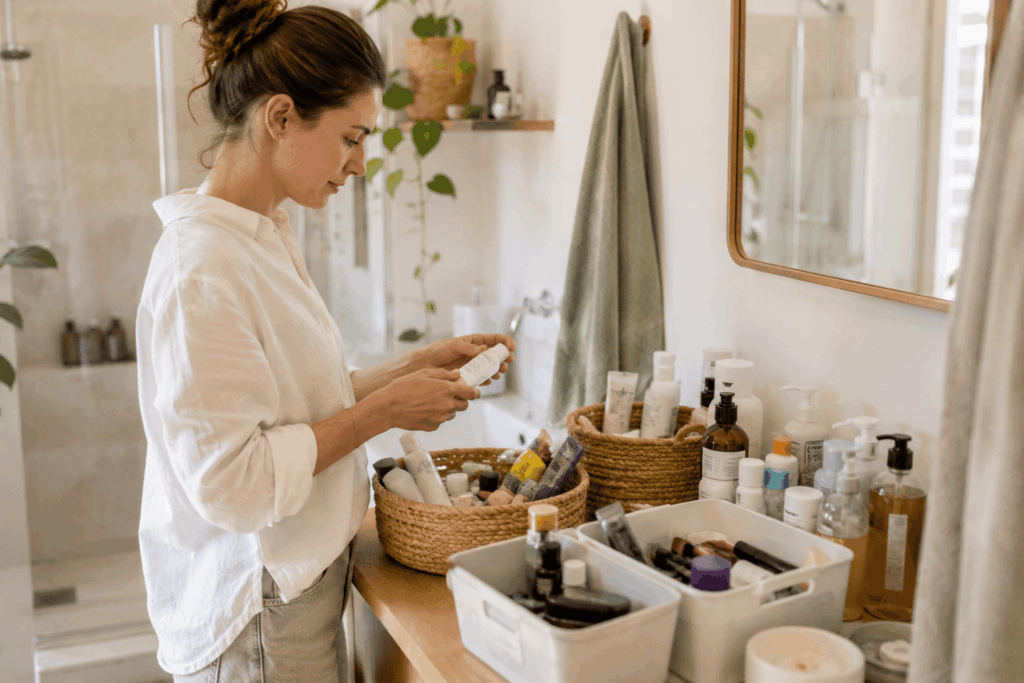
Start with categories that have little emotional attachment: bathroom products, everyday clothes, duplicate kitchen items, useless paperwork…

These categories give you quick visible results. And that changes everything when it comes to motivation.

bathroom organization

Step 3: The simple decluttering method that won’t discourage you

Choose one room… and sort by category

LThe most effective method is neither decluttering the entire house at once, nor organising room by room without any bigger-picture view.
The sweet spot is a hybrid method.

Choose one room to focus on, then gather together all items from the same category — even if some are located elsewhere in the house.

For example, if you’re sorting beauty products in the bathroom, also go grab:

  • the creams in your bedroom
  • the forgotten products in your travel bag
  • the samples hiding at the back of a drawer

Seeing an entire category in one place makes decisions so much easier. And most importantly, it prevents the classic:
“Oh… I didn’t even realise I already had three of these.”

Preparation

Prepare several bags or boxes:

  • to keep
  • to donate (clothes you no longer wear, books you won’t reread)
  • to throw away (broken, expired or mysterious objects whose purpose you no longer remember)
  • to sell (but only if it’s genuinely worth the effort — otherwise it just becomes another task)
  • to return (things that don’t belong to you)
  • to decide later (yes, this category exists, and that’s perfectly OK — but give it a deadline!)

Also prepare a clear surface where you can sort comfortably (a table, or the floor if your back agrees with the idea 😉).

1. Empty everything

Yes. Everything.
Even that tiny drawer that “doesn’t look that full.”

2. Clean before putting things back

Small detail, huge psychological effect. A clean space instantly makes you want to stay organised.

3. Group things by category

Decluttering is a bit like sorting cards: you gather matching families together.

This is often where the big realisation happens.
When all similar objects are finally in the same place, you suddenly see the duplicates clearly (12 dead pens, 5 identical chargers, 7 open face creams…). And suddenly, decisions become much easier.

Step 4: Decide what to keep (without guilt)

The hardest part of decluttering isn’t organising.

It’s deciding.

Whenever you hesitate about an object, ask yourself these three questions:

Does this item actually serve me?

Not “maybe someday.” Not “just in case.” In your real current life.

If something has been sleeping in a cupboard for years, there’s a good chance it’s not that useful after all.

Do I genuinely like this object? Does it bring me joy?

And this isn’t only about decoration.

We often keep things because they were expensive, because someone gifted them to us, or simply out of habit.

But a gift already fulfilled its purpose the moment it was given.

You are not obligated to keep an object that no longer brings you joy or fits your life today.

Would I buy this item again today?

This question is brutally effective.

It helps reveal the difference between:

  • what we truly choose
  • and what we keep simply because we already own it

Very often, the answer is surprisingly revealing.

Support for seniors: sorting and moving

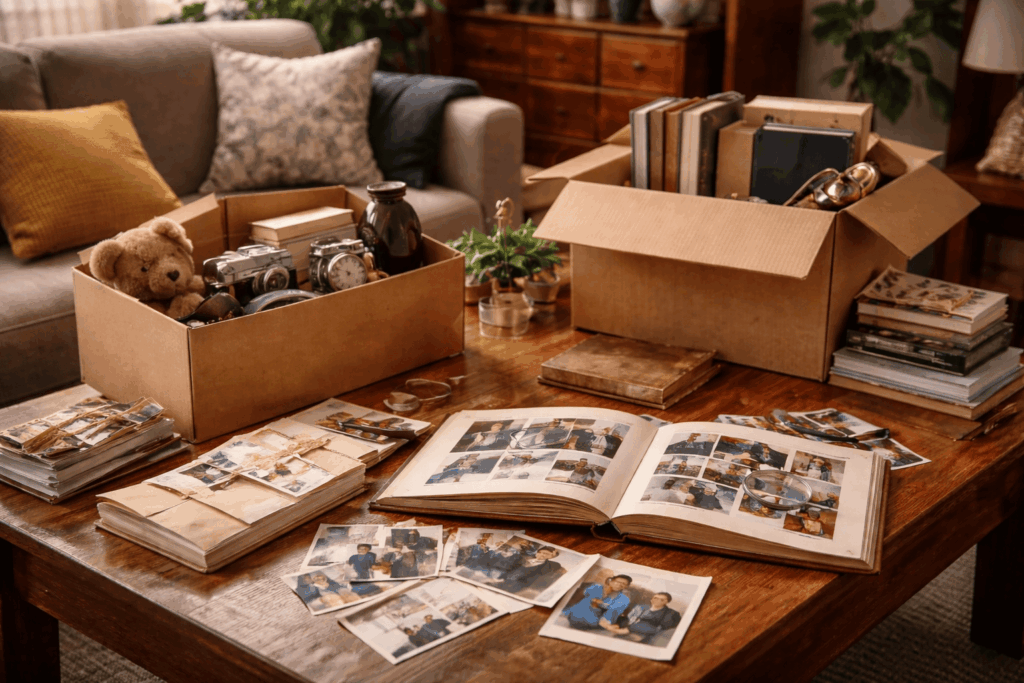
What about sentimental objects?

This is usually the hardest category to declutter.

The goal is not to throw everything away, but to keep what genuinely matters.

One very simple method works extremely well:

  • one memory box per person
  • one clear physical limit
  • photos to preserve certain memories without keeping every object linked to them

A memory doesn’t disappear just because you no longer keep every single object attached to that moment.

Step 5: Organise your home so the clutter doesn’t come back

An effective organising system is one that is simple enough to maintain in real life.

The most common mistake is creating an organisation system that looks beautiful on paper but is too complicated to maintain daily.
If putting something away requires several steps — or even a moment of thinking every single time — that object will inevitably end up abandoned “temporarily” somewhere.
And that’s exactly how clutter returns.

Every object therefore needs a logical home: the most natural place possible for you and for your daily habits.
If your keys always end up near the entrance, there’s no point forcing yourself to store them in a faraway drawer “because it looks tidier.”
If shoes constantly pile up next to the sofa, it’s probably smarter to place a basket or dedicated space there instead of fighting reality.

This is where containers become incredibly useful.
Boxes, baskets or even simple pouches help group similar items together and stop them from spreading everywhere again.
The goal is not to make everything perfectly uniform — it’s simply to give each category a clear boundary.

Labels can also help, even very basic ones.
A simple sticky note is more than enough. The objective isn’t to create a magazine-worthy dressing room, but to avoid the classic “Box 1 / Box 2” situation that nobody understands three months later.

Finally, it’s often useful to think about your home in terms of volume rather than surface area. Not everything needs to remain accessible all the time. Rarely used items can go higher up, seasonal objects can be stored under the bed or in less accessible spaces, and the areas behind doors can become useful storage for lightweight items or everyday accessories. The idea is simply to give every area a clear purpose without overcrowding your living spaces.

En conclusion

Decluttering your home is not about learning how to throw everything away. It’s about learning how to keep what truly has a purpose and a place in your daily life. And that changes far more than just aesthetics: you spend less time searching for things, tidying becomes easier, and your home simply feels more breathable.

The most important thing is not having a perfect home (that doesn’t exist). It’s moving forward at your own pace, making choices that genuinely simplify your life.

And most importantly: be kind to yourself. Decluttering is built little by little — not in one day. Every decluttered space deserves to be celebrated, even the small ones. That’s already real progress.

Need a little help?

If you feel stuck on an organising project, don’t hesitate to call in The Power Rangeuse as backup.
Together, we’ll find creative, effective and easy-to-maintain solutions.
Sometimes, an outside perspective changes everything and helps unlock what felt impossible to sort through alone.

Scroll to Top